
Why Florida homeowners are installing garage door screens

Garage door screens are one of the most practical upgrades a Florida homeowner can make — and one of the most underestimated.
Quick answer: What is a garage door screen?
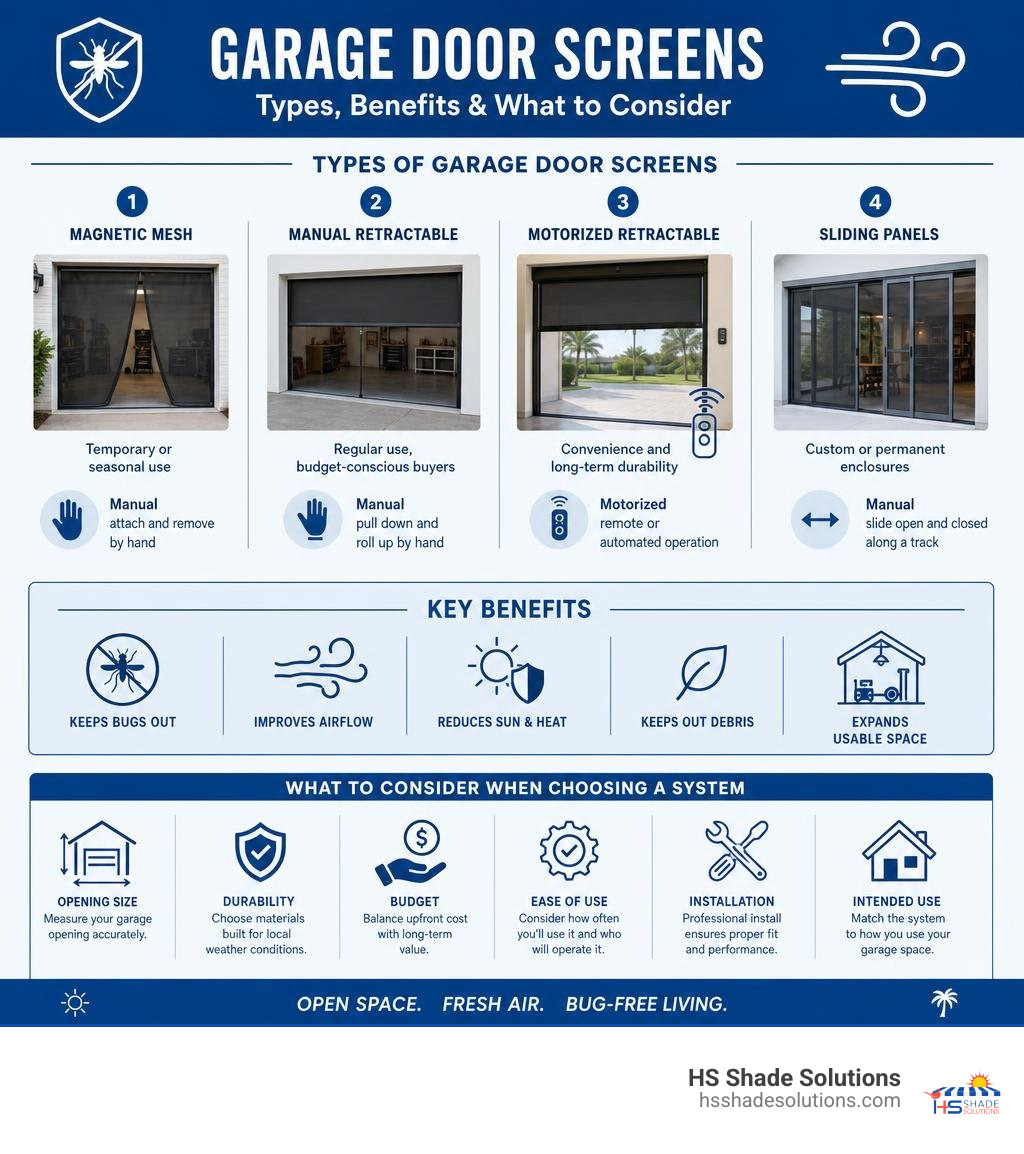
A garage door screen is a mesh screen system installed across your garage opening that lets fresh air in while keeping insects, debris, and harsh sun out. Here’s what you need to know at a glance:
| Type | Best for | Operation |
|---|---|---|
| Magnetic mesh | Temporary or seasonal use | Manual — attach and remove by hand |
| Manual retractable | Regular use, budget-conscious buyers | Pull down and roll up by hand |
| Motorized retractable | Convenience and long-term durability | Remote or automated operation |
| Sliding panels | Custom or permanent enclosures | Slide open and closed along a track |
If you live on Florida’s Space Coast, you already know the problem. The garage door goes up, and within minutes you’re dealing with mosquitoes, no-see-ums, and heat that makes the space nearly unusable. Whether your garage doubles as a workshop, a home gym, or an overflow entertaining space, Florida’s insects and humidity have a way of ending the fun fast.
That’s exactly why more Brevard County and Indian River County homeowners are investing in garage screens — not as a luxury, but as a practical solution to a very real problem.
The right screen system lets you keep your garage door open for airflow and natural light while maintaining a comfortable, bug-free environment. And with options ranging from simple manual setups to fully automated motorized systems built for Florida’s coastal conditions, there’s a solution for nearly every garage, budget, and lifestyle.
This guide will help you cut through the noise and figure out which type of system makes sense for your home — and what to look for before you invest.
Understanding the Main Types of Garage Door Screens
When researching garage screen systems, it becomes clear very quickly that the market is flooded with different designs. These systems generally fall into four main categories, each varying in durability, ease of use, and overall performance.
At the entry-level tier, homeowners often look at temporary magnetic mesh curtains. These are flexible mesh panels that attach to the garage door frame using hook-and-loop fasteners or adhesive tape. They feature a split down the middle secured by magnets, allowing vehicles or people to pass through before snapping shut. While products like the 9 x 7 ft. Fiberglass Garage Door Screen Reinforced Magnetic Mesh for 1-Car Doors with Strong Magnets and Easy Install offer a quick, low-cost fix, they are generally considered temporary. In the intense Florida sun and salt air, these budget screens can quickly degrade or tear.
For a slightly more structured but still budget-friendly approach, there are stationary and roll-up screens. These systems, such as the 16 ft. x 8 ft. Stationary Garage Door Screen with Vinyl Rod Pocket or the 10 ft. x 8 ft. Stationary Garage Door Screen with Mesh Rod Pocket, mount directly to the frame. They can be rolled up manually and secured with straps when you need to drive a car inside, and unrolled when you want to use the space. Some variations, like the 10 ft. x 7 ft. Roll-Up Garage Door Screen with Mesh Rod Pocket or the 16 ft. x 7 ft. Two Car Roll-Up Garage Door Screen with Magnetic Closure, offer a blend of closures for easier access.
For homeowners seeking a more permanent, heavy-duty solution, the choices narrow down to three primary professional systems:
- Manual Retractable Screens: These feature a rigid aluminum frame and a spring-loaded mechanism. When you want to use the screen, you pull it down manually. Some systems utilize a fully integrated frame that sits beneath your existing garage door tracks, while others fold out of the way. Systems like the 16 ft. x 7ft Folding Garage Door Screen System Large Frame offer a sturdier alternative to hanging mesh, but still require physical effort to operate.
- Motorized Retractable Screens: This is the gold standard for modern homes. Operating at the touch of a button, these screens roll up into an aluminum housing mounted above the garage opening. They run along vertical tracks, ensuring a tight seal that prevents pests from slipping past the edges.
- Sliding Panel Screens: Extremely popular in historic and coastal Florida neighborhoods, these consist of multi-panel sliding doors made of durable aluminum frames and mesh. They slide horizontally on tracks, much like a sliding glass patio door. Homeowners in coastal communities often choose these systems when they want a permanent, heavy-duty sliding screen setup that provides easy walk-through access without needing to retract an entire screen roll.
To help visualize how these professional-grade systems stack up against each other, consider this comparison:
| Feature | Manual Retractable Screens | Motorized Retractable Screens | Sliding Panel Screens |
|---|---|---|---|
| Ease of Operation | Manual pull-down; requires some physical effort | Fully automated; remote control or smart home integration | Manual slide; lightweight but requires physical sliding |
| Durability & Lifespan | High with proper maintenance | Maximum durability with high-quality motors and frames | High; tracks require regular cleaning |
| Aesthetic Integration | Visible frame when down; rolls into housing or folds away | Cleanest look; housing blends into the garage header | Permanent vertical frames always visible in the opening |
| Wind & Weather Resistance | Moderate; can flex under pressure | High; tracks secure the mesh edges | High; rigid frames prevent flexing |
| Best Suited For | Budget-conscious homeowners wanting structural durability | Daily use, maximum convenience, and modern aesthetics | Traditional Florida homes; frequent walk-through access |
Key Benefits of Upgrading Your Florida Garage Space
For many households in communities like Viera, Rockledge, and Sebastian, the garage is much more than a parking spot. It is a utility room, a laundry area, a workshop, a home gym, or a playroom for children. However, without proper environmental control, these activities are often cut short by Florida’s intense climate and persistent insect populations.
The most immediate benefit of installing a professional screen is insect protection. Florida’s humid subtropical climate is a breeding ground for mosquitoes, biting midges, wasps, and spiders. A high-quality mesh screen can significantly reduce insect entry while still allowing fresh air to circulate. For coastal areas near the Indian River Lagoon, choosing a specialized, tightly woven mesh is highly recommended, as standard insect screens have openings large enough for tiny biting pests to pass through.
Airflow and thermal comfort are equally important. When a solid garage door is closed, heat gets trapped inside, turning the space into an oven. Opening the door brings relief, but invites pests and direct sunlight. A screen system solves this dilemma by allowing continuous cross-ventilation. This natural airflow, combined with the shade provided by the mesh, can make the garage feel significantly cooler during hot summer afternoons.
Additionally, privacy and sun protection are key advantages. Many premium screen materials act as a one-way mirror during the day. From the outside, passersby see a dark, solid surface, blocking their view of your tools, fitness equipment, or laundry area. From the inside, however, you maintain a clear view of your driveway and neighborhood. These specialized fabrics also block a significant portion of harmful UV rays, protecting your skin during workouts and preventing your stored belongings, vehicle interiors, and tools from fading or deteriorating under sun exposure.
By converting this underutilized area into a comfortable, bug-free environment, you effectively expand your home’s usable square footage without the massive expense, permitting delays, and construction headaches of a traditional home addition. To explore how high-quality screening can transform your property, consider looking into professional Screen Solutions that are custom-designed for coastal environments.
Motorized vs. Manual Garage Door Screens: Convenience and Durability
Choosing between a motorized system and a manual system is one of the most critical decisions in the planning phase. Both styles have their place, but they offer vastly different daily experiences and long-term performance.
In the coastal environment of the Space Coast—stretching from Cape Canaveral down to Micco and Grant-Valkaria—materials are put to the test daily. Salt air, high humidity, and intense sun can quickly corrode cheap metals, degrade low-grade plastics, and rot standard fabrics. Therefore, understanding how these systems operate and hold up over time is essential.
Selecting the Best Motorized Garage Door Screens
Motorized screens represent the pinnacle of convenience and structural integrity. Operating on a motorized roller system, these screens glide smoothly down vertical tracks mounted to the sides of the garage opening. Because they are controlled via a remote, wall switch, or smart device, there is zero physical strain involved. This makes them an excellent choice for homeowners with limited mobility or those who use their garage multiple times a day.
From a design and durability standpoint, motorized systems offer several distinct advantages:
- No Floor Tracks: Unlike sliding panels, motorized screens do not require a track installed along the floor. This eliminates a common tripping hazard and prevents wheels from getting jammed by dirt, leaves, or driveway debris.
- Secure Edge Seals: Premium motorized screens utilize secure track systems. The edges of the screen fabric run securely inside the tracks. This prevents the screen from blowing out during windy days and creates a complete, gap-free seal against crawling and flying insects.
- Wind Resistance and Safety: High-quality motorized systems are built with heavy-duty aluminum frames that resist bending and corrosion. Many systems can also integrate with home automation, allowing them to retract smoothly when not in use.
- Aesthetic Preservation: When retracted, the entire screen rolls up into a sleek, color-matched aluminum housing mounted discreetly above the door header, completely preserving your home’s curb appeal.
For homeowners looking to maximize comfort, control heat, and invest in a system that will provide long-term performance, exploring customized Shade Solutions is a highly reliable path forward.
Evaluating Manual Garage Door Screens for Daily Use
Manual screens are a dependable, budget-conscious alternative to motorized automation. These systems typically utilize a spring-loaded counter-balance mechanism, similar to a standard window shade or manual garage door, making them relatively easy to pull down and push up.
Key characteristics of quality manual screens include:
- Passage Doors: Because manual screens are physically locked into place when lowered, many designs feature an integrated, swing-style passage door. This allows you to walk in and out of the garage without having to retract the entire screen system.
- Dependable Performance: With fewer electrical components, manual systems have fewer parts that can fail over time. This makes them highly reliable, especially during power outages caused by summer storms.
- Budget-Friendliness: Manual systems offer a heavy-duty, framed solution at a lower initial investment than automated motorized systems.
While they require some physical effort to operate and do not offer the seamless, hands-free convenience of motorized units, a professionally installed manual system is still vastly superior to cheap, flimsy retail kits.
Cost Factors, Lifespan, and Professional Installation Realities
When planning a garage screen project, it is important to understand that pricing is not one-size-fits-all. The total investment for a custom screen system depends heavily on several key variables:
- System Type: Manual roll-up systems are generally more economical, while fully motorized, automated systems represent a larger upfront investment due to the cost of high-quality motors, remote controls, and specialized track systems.
- Project Size: A standard single-car garage door requires less material and labor than a double-car garage door or a custom over-sized opening.
- Customization and Materials: Opting for specialized mesh (such as ultra-fine mesh or heavy-duty pet-resistant screen) and custom-painted frame finishes to match your home’s trim or HOA requirements will influence the final cost.
- Site Complexity: Hard-to-reach mounting areas, limited headroom clearance, or the need to modify existing trim to accommodate the housing can add complexity to the installation process.
Rather than looking at a screen as a temporary purchase, it should be viewed as a long-term home improvement. While a cheap, DIY magnetic mesh kit from a retail store might seem appealing, those systems are highly prone to tearing, sliding out of alignment, and degrading under UV exposure. In contrast, a professionally installed manual system can offer lasting durability, and a premium motorized system built with high-quality aluminum and motors can perform flawlessly for the long term with basic care.
Professional installation is particularly critical for motorized systems. These units feature heavy aluminum housings and precise tensioning mechanisms that must be perfectly level to prevent the screen from binding, wrinkling, or jumping off its tracks. Furthermore, professional installers ensure that the system is safely anchored to your home’s structural framing, enabling it to withstand coastal wind loads. They also handle the necessary electrical connections and calibrate the limits of the motor for smooth, long-term operation.
For homeowners in storm-prone coastal areas, understanding how your screen systems interact with overall wind loads and home protection is vital. To learn more about protecting your home from extreme weather while maintaining outdoor comfort, read through our comprehensive Hurricane Screens Guide or explore our heavy-duty Hurricane Screens designed specifically to withstand severe coastal storms.
Frequently Asked Questions About Garage Screens
To help you make an informed decision for your home, here are answers to some of the most common questions homeowners ask when considering a garage screen system.
Can garage screens be used with all types of garage doors?
Yes, professional screen systems are compatible with almost all standard residential garage doors, but the installation approach depends on the style of your door.
Most modern homes feature sectional roll-up garage doors that slide up and along tracks parallel to the ceiling. Because professional screen systems mount directly to the wood or stucco door jamb on the exterior face of the garage opening, they operate completely independently of your garage door. You can have your garage door fully closed with the screen retracted, or you can open your garage door and lower the screen to enjoy a bug-free breeze.
However, if your home has an older, one-piece tilt door (which swings outward before moving overhead), a standard exterior-mounted screen may interfere with the door’s path. In these rare cases, a professional installer will need to perform a detailed site assessment to determine if a specialized interior mount or a sliding panel system is required.
How do professionals measure a garage door opening for a screen?
To ensure a flawless, airtight seal, professional installers perform precise measurements of the opening. They assess the width, height, and available clearance around the frame to account for any settling or unevenness in the structure. This custom approach ensures that your screen fits snugly against the frame, leaving absolutely no gaps for insects to exploit.
Do garage screens block wind, rain, and extreme Florida heat?
Standard mesh screens are designed primarily for insect control and ventilation, meaning they will not stop heavy rain or strong winds. However, the type of mesh fabric you select can have a major impact on how your garage handles the elements.
If your primary goal is heat reduction and privacy, you can opt for solar screens. These tightly woven fabrics are designed to block a significant portion of solar heat gain and glare, keeping your garage noticeably cooler during hot summer days. While these screens still allow fresh air to pass through, their dense weave also provides a helpful barrier against light, wind-blown rain and blocks the view of your garage interior from the street.
For a look at how these custom screen systems perform in real-world coastal environments, you can browse through some of our local Residential Projects.
Conclusion
Transforming your garage from a hot, bug-ridden storage space into a comfortable, multi-purpose room is one of the most rewarding home improvements you can make. Whether you envision a high-tech home gym in Melbourne, a peaceful woodworking shop in Titusville, or a breezy coastal lounge in Palm Bay, a professional garage screen system makes it possible.
While cheap retail screens may offer a temporary fix, they simply cannot withstand the harsh salt air, high humidity, and intense UV rays of Florida’s Space Coast. Investing in a professionally designed and installed system ensures that your screen will operate smoothly, look beautiful, and protect your home for many years to come.
As a trusted, local Florida contractor specializing in custom sun control, shade, and coastal protection, HS Shade Solutions is dedicated to helping homeowners maximize their outdoor and semi-outdoor living spaces. If you are ready to evaluate the best options for your home and take the first step toward a cooler, bug-free garage, contact the local experts at HS Shade Solutions today to schedule a professional consultation and request a custom estimate for your premium Screen Solutions.